






Published: September 20, 2026
Smoke Alarm Requirements in NSW: What the Law Actually Says
Search for smoke alarm rules and you will find a lot of confident advice about interconnected alarms, photoelectric sensors and hard deadlines. Much of it is accurate. Almost none of it is about New South Wales.
Queensland brought in considerably stricter requirements several years ago. Because that content ranks well and gets shared widely, plenty of Sydney homeowners and landlords believe rules apply to them that simply do not. Here is what NSW actually requires, what it recommends, and where the two are worth telling apart.
The legal minimum in NSW
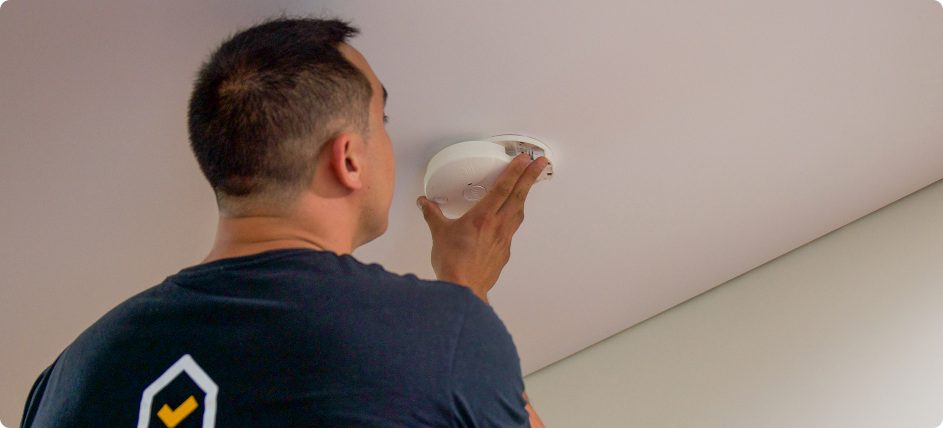
Smoke alarm requirements in NSW sit under the Environmental Planning and Assessment (Development Certification and Fire Safety) Regulation 2021. Alarms have been mandatory in some new buildings since the early 1990s, and that was extended in 2006 to cover all existing homes. The law sets three things.
A working alarm on every level. Every storey needs at least one, including storeys with no bedrooms on them. On those levels the alarm goes on the likely escape path, usually near the stairs.
Alarms that meet AS 3786. The standard is printed on the body of the unit. Alarms that do not carry it are not compliant, even if they work.
Correct placement. Alarms belong in the hallway serving the bedrooms. Where bedrooms sit in separate parts of the house, each of those areas needs its own. Where there is no hallway, the alarm goes between the sleeping area and the rest of that level.
This covers houses, apartments, rental properties, relocatable homes, caravans and campervans. Older houses are not exempt. There is one narrow exception. An alarm installed before May 2006 that does not meet AS 3786 can stay until it stops working or is removed, as long as it sits in a compliant location.
So is interconnection required in NSW?
No. Interconnected alarms, where one detecting smoke sets off every alarm in the house, are not required under NSW law for existing homes. Neither is photoelectric sensing. Both belong to Queensland, where stricter smoke alarm laws have been phased in since 2017 and interconnected photoelectric alarms are required in every bedroom, every connecting hallway and on every storey of all homes by 1 January 2027.
Worth being clear about what that does and does not mean. Interconnection is not mandatory here, and it is still the single biggest improvement most homes can make. A standalone alarm in a downstairs hallway will not reliably wake someone asleep upstairs behind a closed door, which is exactly the scenario Queensland’s rules were written for.
One caveat. New builds, alterations and additions fall under the National Construction Code rather than the existing-home minimum above, and the Code asks for more. Do not assume an existing-home standard applies to a renovation project.
What Fire and Rescue NSW recommends beyond the law
The legislation sets a floor rather than a target, and Fire and Rescue NSW says so directly. Its recommendation is an alarm in every bedroom, not just the hallway outside them.
The reasoning is straightforward. Most fatal house fires happen while people are asleep, and a closed bedroom door delays smoke reaching a hallway alarm by minutes you may not have. If you are spending anything beyond the minimum, bedrooms are where the evidence points.
If you rent your property out
Landlord obligations changed in March 2020 and are more specific than most people realise. They are not satisfied by having alarms installed and forgetting about them.
| Obligation | What it means in practice |
|---|---|
| Keep alarms in working order | The duty sits with the landlord or agent, not the tenant, for the life of the tenancy. |
| Repair within 2 business days | Once you know an alarm is not working, including a flat battery, you have two business days to fix it. |
| Check every year | An annual test of every alarm is required. Document when it was done. |
| Replace within 10 years | Alarms expire. Replace within 10 years of the manufacture date on the unit, or sooner if the manufacturer says so. |
| Replace batteries annually | Every year for standard batteries, or within the manufacturer’s stated period for lithium units. |
| Give correct notice | At least 2 business days’ notice to inspect or assess, and at least 1 hour’s notice to carry out a repair or replacement. |
Neither party may remove or interfere with an alarm without a reasonable excuse, and doing so is an offence in its own right. Where a property is managed by an agent, the legal responsibility still rests with the owner, which catches a number of landlords out. A yearly service across a portfolio is usually cheaper and simpler than handling each property as it comes up.
If you are renting
Tenants have a narrower but real set of duties. Tell your landlord or agent as soon as you find an alarm that is not working, including when the battery needs changing. Let them know if you change a battery yourself, or if you are physically unable to.
Removing an alarm because it keeps chirping is the one thing not to do. Beyond the obvious risk, it breaches the tenancy rules. A chirping alarm is usually either a flat battery or a unit that has passed its ten year life.
Photoelectric or ionisation?
Both types meet AS 3786, so either is legal in an existing NSW home. They detect fire differently. Ionisation alarms respond well to fast-flaming fires, and photoelectric alarms respond faster to the slow, smouldering fires that start in furniture, bedding and wiring while people are asleep.
Photoelectric is the type fire services generally recommend for homes, and it is what Queensland’s rules now specify. It also nuisance-trips less often near a kitchen, which matters more than it sounds. An alarm taken down because it went off every time somebody made toast protects nobody.
Where an alarm would be set off constantly by normal activity, a kitchen being the usual culprit, NSW rules allow a heat alarm in place of a smoke alarm in that location. That is a better answer than moving the alarm somewhere useless.
Where alarms go on the ceiling or wall
Placement inside a room matters as much as which rooms are covered. Alarms mount on or near the ceiling, and the thing to avoid is dead air space, a pocket where trapped air stops smoke reaching the sensor. That happens at the apex of a cathedral ceiling, in the corner junction of wall and ceiling, and between exposed floor joists.
Ceiling mounting is preferred wherever it is practical
On a wall, the top of the alarm sits 300mm to 500mm below the ceiling
Under a cathedral ceiling, keep the alarm 500mm to 1500mm down from the apex
Keep alarms clear of cooking appliances and bathrooms to limit false alarms
Hardwired alarms and when to call an electrician
For a private home in NSW, the choice between hardwired and battery powered is yours. Battery-only alarms are a job you can do yourself. Hardwired alarms, which run off mains power with a battery backup, must be installed by a licensed professional. If your existing alarms are hardwired, replacing hardwired units means the replacements need to be hardwired too.
This is also the point where interconnection gets decided, since wiring alarms together happens at installation. If you are replacing hardwired units that have reached ten years, doing it as one job and interconnecting them at the same time costs considerably less than revisiting it later.
Licensed electricians at Aussie Home Services install and replace smoke alarms across Greater Sydney, the Blue Mountains, the Central Coast and the Southern Highlands under NSW licence 273594C. Every job is quoted at a fixed price before it starts, and you receive a Certificate of Compliance for Electrical Work when it is finished. Call 1300 164 206 or book a smoke alarm installation online.
Request a Quote
"*" indicates required fields