





Upfront Pricing, No Hidden Costs

24/7 Emergency Services

Lifetime Labour Guarantee
Upfront Pricing, No Hidden Costs
24/7 Emergency Services
Lifetime Labour Guarantee



Plumber Blue Mountains
A plumber in the Blue Mountains deals with colder water, sandstone under the house and older homes, and a burst pipe in Katoomba in July is a different job to a burst pipe in Penrith. The water is colder, the ground underneath is often solid sandstone, and the house is frequently older than anything on the plain below. What fails up here, and how it is best repaired, changes with the altitude.
Finding a plumber in the Blue Mountains who knows that difference matters more than it does in most parts of Sydney. Our licensed plumbers work the full length of the region, from Lapstone and Glenbrook at the bottom through to Blackheath and Mount Victoria at the top, under NSW licence 273594C.
Burst pipe, blocked drain or no hot water, someone answers at any hour of the day or night. Call 1300 164 206 and you will get a realistic arrival window rather than an optimistic one.
Who will be working at your Blue Mountains property?
Aussie Home Services is a family owned business and has worked across Sydney since 2009. Our plumbers work under NSW contractor licence 273594C, which covers plumbing, gasfitting and draining work, and the team is fully insured.
The plumber who attends in Blue Mountains is one of our own licensed team. Our Lifetime Labour Guarantee covers labour if our workmanship causes a failure and the work is defective. It doesn’t cover parts.
What plumbing work comes up most across the Blue Mountains?
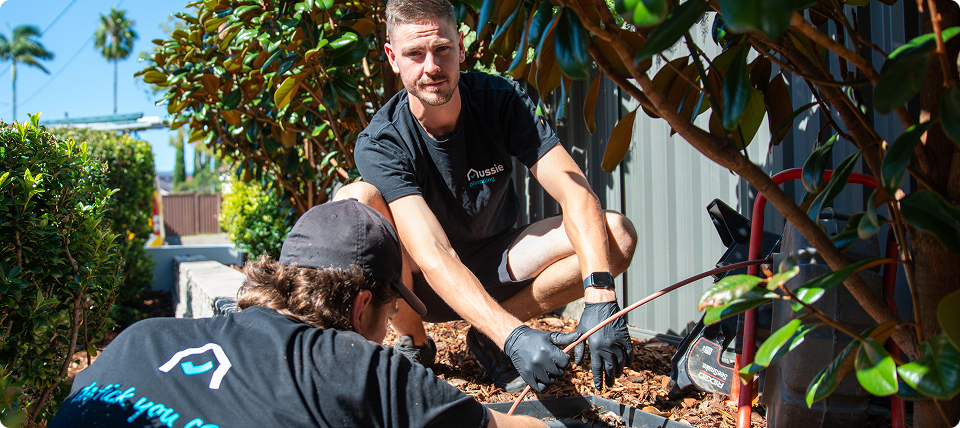
Four problems account for most of what we are called out to in this region, and each one traces back to something about the Mountains themselves.
Blocked drains lead by a wide margin. Established eucalypts on large blocks send roots into older clay sewer lines, and once a joint is cracked the blockage comes back every season until the pipe itself is dealt with. Clearing it is the easy part. Tree root blockages are the reason it returns.
Hot water failures spike through winter because systems up here work harder than the same unit would in western Sydney. Incoming water is colder and recovery takes longer, so a unit that was borderline in March gives up in July. We handle both fixing a failed hot water unit and replacing an ageing system where repair no longer stacks up.
Leaking and burst pipes cluster in the Upper Mountains after a hard frost, almost always on exposed external pipework rather than anything inside a wall. Where a leak is hidden and the only symptom is a rising water bill, tracing a hidden leak comes before any digging.
Damaged sewer and stormwater lines are the fourth. Shallow sandstone makes excavation slow and expensive here, which is why no dig pipe repair is so often the better answer in this region even when it would be a close call elsewhere.
Beyond those four, the team covers gas fitting and appliance connections, toilet and cistern repairs, tap and mixer replacement, water filtration, rainwater tank connections, and backflow prevention testing.
Licensed, local and priced before we start
Aussie Home Services has been working across Sydney and the Mountains since 2009, holding NSW licence 273594C. Every job is priced before it starts, and that price does not move once work is underway unless you approve a change. There is no call-out fee on appointments booked for the next day or later.
Our Lifetime Labour Guarantee covers defective workmanship, and you receive a Certificate of Compliance for any plumbing and drainage work that requires one. Households needing a plumber more than once or twice a year tend to find our maintenance membership pays for itself: 15 percent off every job, $50 off your first visit, one free emergency callout a year and an annual maintenance check.
Who regulates plumbing work in the Blue Mountains?
This catches people out, because the answer is not the council. The Blue Mountains sits inside the metropolitan plumbing inspection area alongside Sydney, the Illawarra, Newcastle and the Hunter, which means Building Commission NSW is the plumbing regulator here rather than Blue Mountains City Council.
In practice that means two pieces of paperwork, both the plumber’s responsibility rather than yours. A Notice of Work is lodged before starting any job that requires an inspection. A Certificate of Compliance is completed at the end, given to whoever arranged the work, and submitted to Building Commission NSW. That certificate is what confirms the work meets the Plumbing and Drainage Act 2011, the Plumbing Code of Australia and AS/NZS 3500, and it names the licensed plumber responsible for it.
Not every job needs one. Emergency work is exempt, as is minor work such as replacing tapware, swapping a hot water system like for like, or a bathroom renovation where no fixture moves. If a job does require certification, you should be given the certificate without having to ask for it.
Worth knowing if you are selling: a Sewer Service Diagram showing where the drainage runs on your property is often requested during conveyancing, and it comes out of this same process. Blue Mountains City Council still handles development approvals and anything touching a heritage listing, which is a separate question from the plumbing certification above.
How does plumbing differ between the Lower and Upper Mountains?
The drive from Glenbrook to Mount Victoria climbs roughly 900 metres. Along the way the soil gets thinner, the sandstone gets closer to the surface, the winters get harder and the housing gets older. Three bands, three sets of problems.
Lower Mountains: Glenbrook, Blaxland, Warrimoo and Lapstone
Closest to the Nepean plain and climatically more like Penrith than Katoomba. Frost is uncommon. The housing mix leans post-war and later, so the recurring jobs are hot water systems, stormwater that cannot cope with a downpour, and copper pipework from the 1960s and 1970s reaching the end of its life. Blocks on the escarpment side fall away steeply, and getting the fall right on a drainage line matters far more on a slope than it does on flat ground.
Mid Mountains: Springwood, Winmalee, Faulconbridge, Hazelbrook and Lawson
Springwood is the largest centre in the Mountains and generates more plumbing work than any other suburb in the region. Larger blocks with established eucalypts produce the single most common problem we see here. Older earthenware and vitrified clay sewer lines were laid in short sections with a joint every metre or so, and roots find them through the smallest gap. Much of this area also sits in a bushfire-prone zone, which affects how external pipework and tank connections are specified.
Upper Mountains: Wentworth Falls, Leura, Katoomba and Blackheath
Above about 900 metres the climate becomes the main factor. Katoomba and Blackheath record regular winter frosts and occasional snow, and anything holding water on the outside of a building is exposed to it. Burst pipes here tend to happen on the thaw rather than the freeze. Much of the housing stock is genuinely old, with heritage cottages through Katoomba, Leura and Blackheath often retaining original drainage. Combined with shallow sandstone that turns excavation into rock breaking, that pushes the answer toward relining wherever the pipe can still take it.
Need a plumber in the Blue Mountains?
Call 1300 164 206 any hour of any day. You will get a fixed price before the work starts and a realistic arrival time before anyone gets in the van.
How much does a plumber in Blue Mountains cost?
The price is fixed and agreed before any work starts. Our plumber looks at the problem, explains what they’ve found and gives you a quote. Once you approve it, that’s the price you pay.
What sets the price is the job itself: the fault, how easy it is to reach and the parts it needs. Quotes are free, and there’s no call-out fee when you book for the following day or later.
Request a Quote
"*" indicates required fields
Plumbing Services for Blue Mountains Homes
Blocked Drains Blue Mountains
The Blue Mountains’ mature vegetation, clay soils and ageing drainage systems make blocked drains a frequent issue in local homes. If you’re dealing with gurgling pipes, overflowing fixtures or slow-draining sinks, our specialists use CCTV cameras and jet blasting to uncover what’s causing the blockage. Homeowners often contact us about ongoing drainage problems made worse by tree roots and shifting soil on steep blocks. Where we find structural damage underground, cracked or collapsed pipes, we offer modern repair methods that protect your garden and landscaping. Many locals choose our non-invasive pipe restoration solutions over large-scale excavation.Our plumbers also install and test backflow prevention devices and connect water meters across Blue Mountains.
Emergency Plumber Blue Mountains
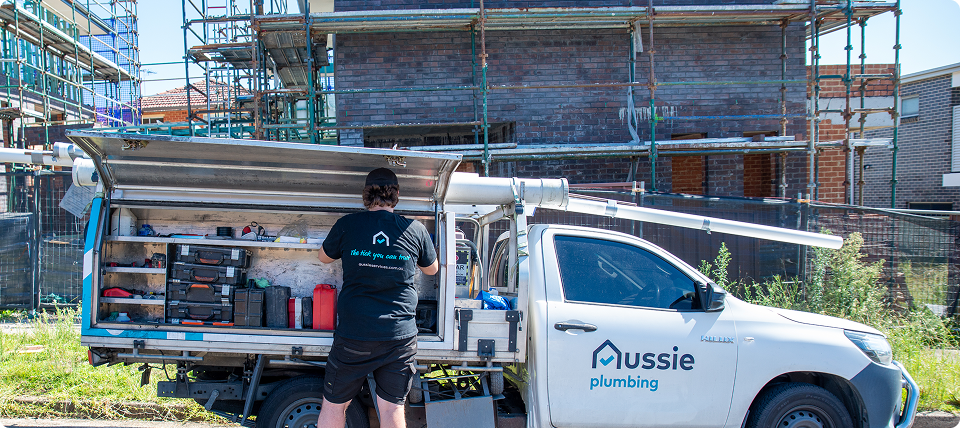
Storm damage, sudden bursts and rapid flooding can happen without warning across the Blue Mountains, especially in properties built on slopes or near dense bushland. Our emergency plumbers operate 24/7 and regularly respond to urgent calls across Katoomba, Springwood, Blaxland, Leura and the surrounding areas. If you’re not sure whether your situation counts as an emergency, call anyway, we’ll advise you over the phone and dispatch help immediately if there’s any risk to your property or family.
Hot Water Repairs Blue Mountains
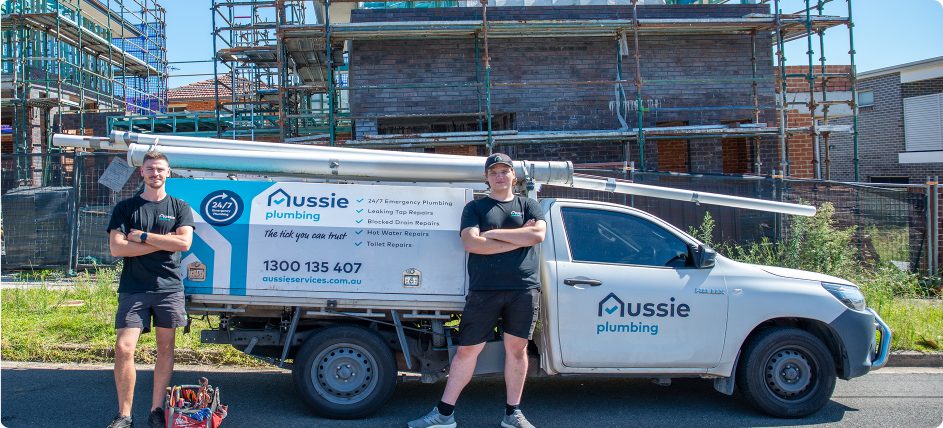
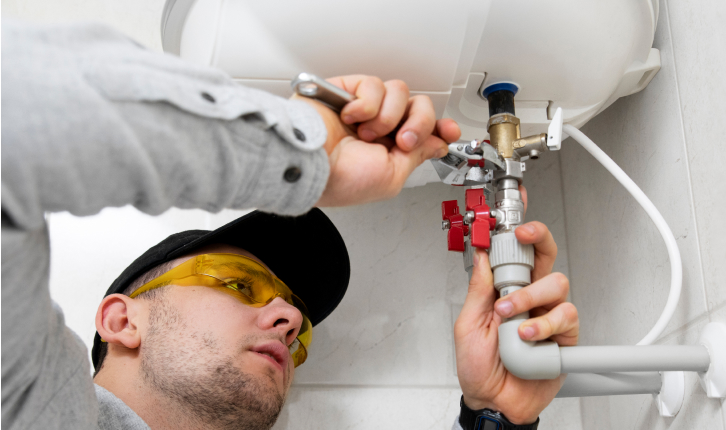
Cold climate conditions in the Blue Mountains mean hot water systems work harder, and fail more often, than they do closer to the coast. If you’re dealing with temperature inconsistencies, rusty water, leaks or a complete outage, we diagnose the issue and aim for same-day repairs. We handle hot water system repairs on electric, gas, instant and heat pump units, and can recommend a replacement suited to your household’s size and energy needs if repair isn’t the better option.
Leaking Pipes Blue Mountains
Older homes, shifting land and invasive tree roots mean leaks can escalate quickly in the Blue Mountains. Even a small leak can lead to mould, damp smells, bubbling paint or a water bill that doesn’t add up. Our plumbers use acoustic detection, pressure testing and thermal imaging to find the source before we open anything up. Residents frequently contact us about hidden water leaks that need fast, accurate diagnosis rather than guesswork, whether it turns out to be a small repair or a full pipe upgrade.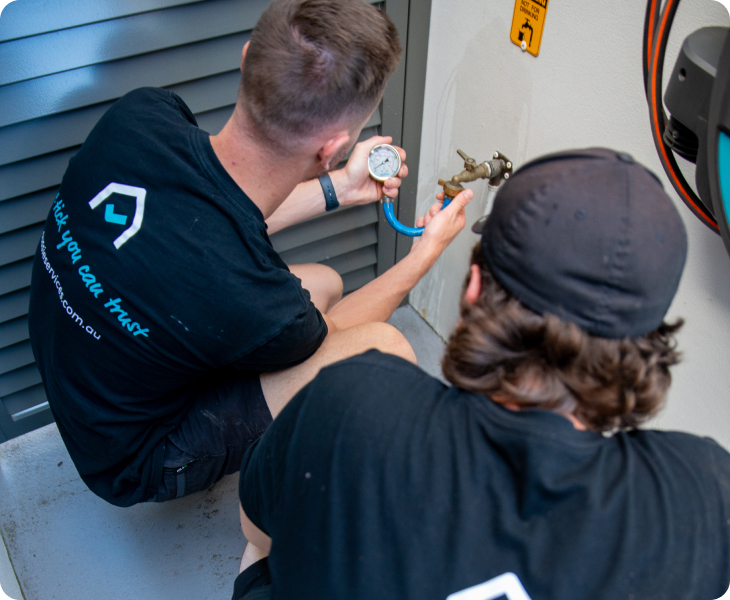
Gas Fitting Blue Mountains
Homes across the Blue Mountains rely heavily on gas appliances for heating through the colder months. Whether you’re replacing a cooktop, updating a heating appliance or investigating a suspected leak, our licensed gas fitters complete all work safely and to code. Many properties also count on our gas plumbing team for system upgrades that improve performance through winter. If you can smell gas or suspect a leak, that’s not one to wait on. Our gas leak detection team responds fast with the right equipment to find and repair it safely.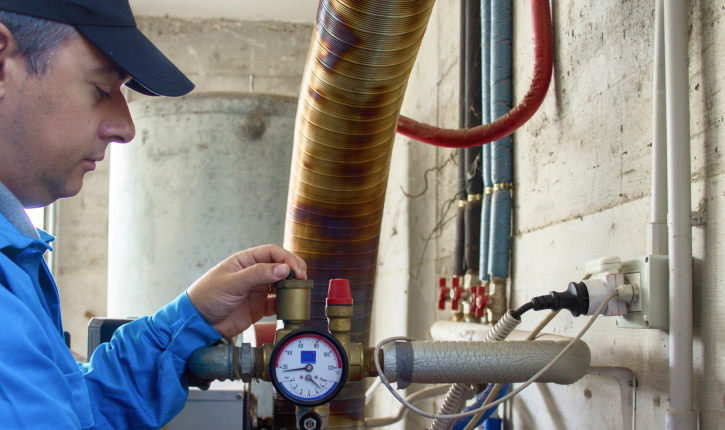
Plumbing across the Lower, Mid and Upper Mountains
Two properties twenty minutes apart on the Great Western Highway can present completely different plumbing problems. The drive from Glenbrook to Mount Victoria climbs roughly 900 metres, and along the way the soil gets thinner, the sandstone gets closer to the surface, the winters get harder and the housing gets older. What fails, and how it is best repaired, changes with it.
Lower Mountains: Glenbrook, Blaxland, Warrimoo and Lapstone
The Lower Mountains sits closest to the Nepean plain and shares more with Penrith than with Katoomba. Frost is uncommon, and the housing mix leans toward post-war and later builds alongside newer development. Most callouts here involve hot water systems, blocked stormwater after heavy rain, and the copper pipework typical of homes built through the 1960s and 1970s reaching the end of its service life.
Blocks on the escarpment side tend to fall away steeply, which puts pressure on stormwater and surface drainage during a downpour. Getting the fall right on a drainage line matters more on a slope than it does on flat ground, and it is the part most often done badly by whoever came before.
Mid Mountains: Springwood, Winmalee, Faulconbridge, Hazelbrook and Lawson
Springwood is the largest centre in the Mountains and generates more plumbing work than any other suburb in the region. Properties here typically sit on larger blocks with established eucalypts, and that combination produces the single most common problem we deal with across the Mid Mountains.
Tree roots find sewer lines through the smallest gap in a joint, then expand until the pipe cracks. Older earthenware and vitrified clay lines are particularly vulnerable, because they were laid in short sections with a joint every metre or so. A jet blast clears the blockage. It does not fix the crack that let the roots in, which is why the same drain blocks again the following season. Relining the pipe from the inside seals the joints permanently without digging up the garden that caused the problem.
Upper Mountains: Katoomba, Blackheath, Wentworth Falls and Leura
Above about 900 metres the climate becomes the main factor. Katoomba and Blackheath record regular winter frosts and the occasional snowfall, and anything holding water on the outside of a building is exposed to it. Outdoor taps, exposed pipe runs under a raised floor, and poorly lagged supply lines to a laundry or an outbuilding are the usual failure points, and they tend to burst on the thaw rather than the freeze.
Hot water systems work considerably harder up here. A unit sized correctly for a house in the Lower Mountains will struggle with the same household in Blackheath, because the incoming water is colder and the recovery time is longer. Where a system is being replaced rather than repaired, sizing it for the local climate is worth more than the price difference between models.
Much of the Upper Mountains housing stock is genuinely old. Heritage cottages through Katoomba, Leura and Blackheath often retain original drainage, and shallow sandstone makes excavation slow and expensive. Both of those push the answer toward no-dig repair wherever the pipe can still take it.
What sandstone means for a drainage repair
Digging a trench in the Blue Mountains is rarely a matter of digging. Sandstone often sits within half a metre of the surface, and once a machine reaches rock the job changes from excavation to rock breaking. That is slower, noisier, harder on the garden and considerably more expensive.
It is the reason relining is so often the better answer here, even where it would be a close call elsewhere. A liner is fed through the existing pipe and cured in place, so the ground stays where it is. Where a pipe has collapsed completely, excavation is unavoidable, and knowing that before quoting is the difference between a fixed price and a surprise.
Getting to you across the Mountains
Response times vary across the region, and pretending otherwise would be misleading. The Mid and Lower Mountains are the quickest to reach, and the Upper Mountains and the Megalong and Kanimbla valleys take longer, particularly in poor weather or when the highway is affected. You are given a realistic window when you call rather than an optimistic one.
For an emergency, turning off the water at the meter is the most useful thing you can do while waiting. If you are not sure where the meter is or whether the situation counts as urgent, call 1300 164 206 and you will be talked through it. Our plumbers across Sydney cover the region every day.
About Aussie Home Services
Since 2009, our team has supported Sydney homeowners with plumbing and electrical work built around transparent pricing and long-term fixes. We work throughout the Blue Mountains daily, bringing experience from years in older cottages, bushland homes and modern renovations, backed by our broader Sydney-wide service coverage. If it is the wiring rather than the pipework, our electricians in the Blue Mountains cover the same region. Every technician is licensed, insured and trained to provide reliable work that protects your home. Across every job, our goal stays simple: make home maintenance straightforward, safe and stress-free.
Need a Trusted Plumber in the Blue Mountains?
Your plumbing issue deserves proper attention from a team that actually knows the region. Call 1300 164 206 today, and our local technicians will organise a time that suits you.
Testimonials
Great Services, Happy Clients
Read what homeowners, landlords and businesses say about working with our plumbers.






Blue Mountains plumbing FAQs
Other Blue Mountains areas we service
We service businesses across Blue Mountains and beyond. These are just some of the local areas we cover.

Save $50 On Initial Visit and 15% OFF Every Job Using AHS Cover Care